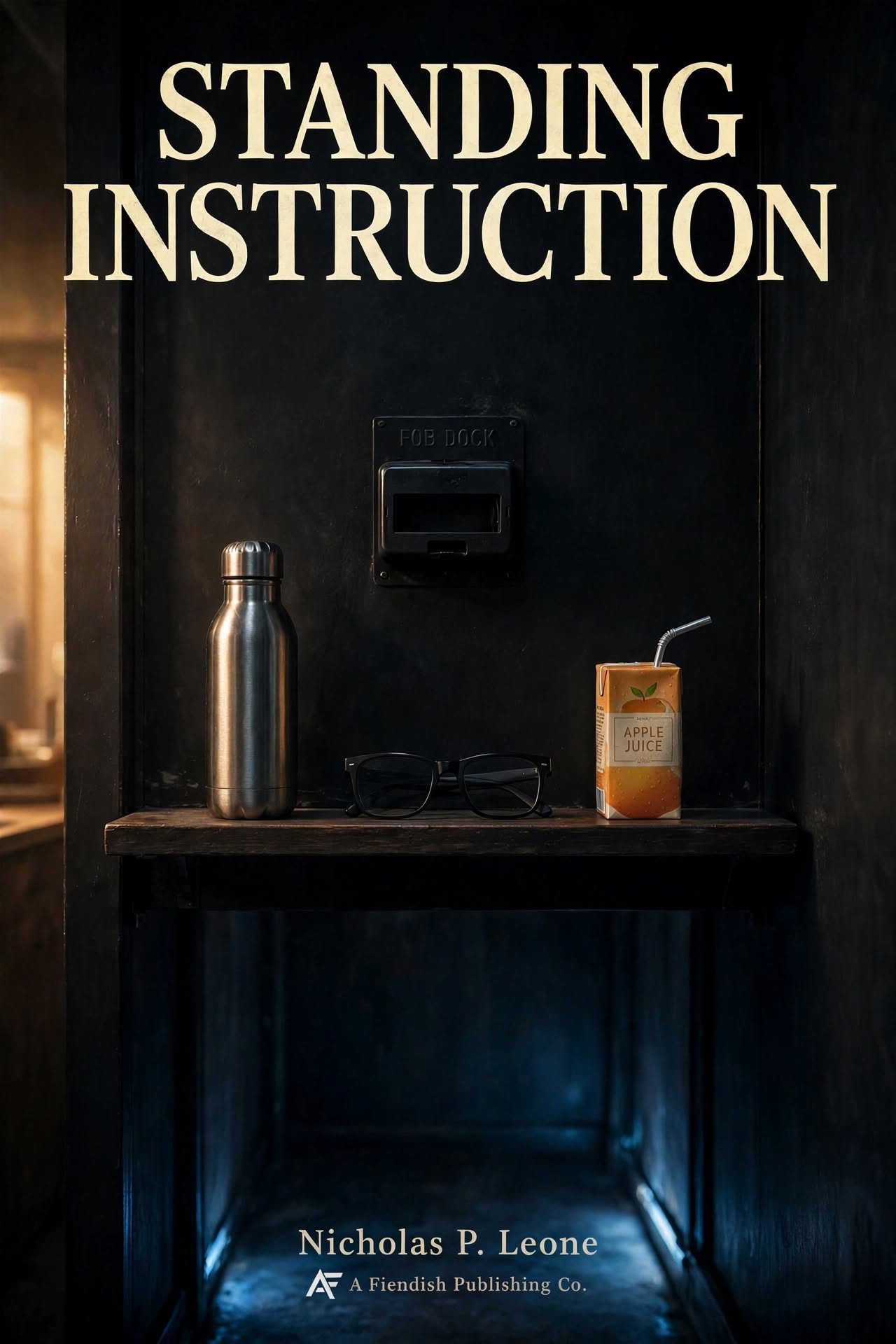
No. 001 · In Revision
Margin of Error Nicholas P. Leone
Short novel · Forensic tragedy
Nick always swore he would live to 105.
A margin of error is not a boundary. It is the distance a careful man can die inside.
A Fiendish
Publishing Co.
The Catalog / No. 001
No. 001 · In Revision
Short novel · Forensic tragedy
Nick always swore he would live to 105.
A margin of error is not a boundary. It is the distance a careful man can die inside.
The Book
He survives something absurd in his own bathroom — a mouse, a heated bidet seat hot enough to fuse to skin, and a standby generator that does everything right. Fourteen weeks later he dies on an operating table during a power failure in which nine of the hospital’s ten transfer switches do exactly what they were built to do.
His best friend Curtis — executor, thirty-plus years of Saturdays — finds an unfinished list in Nick’s handwriting and a note on the refrigerator: Ask Curtis about the road...
Thirty years ago an argument broke up a three-car convoy on a New Mexico road. A drunk driver hit the lead car, and the spacing saved everyone behind it. Or seemed to.
Then the obituaries start. Curtis opens a column of dates. Feb 19. May 28. Sep 26. Oct 27. Dec 10. The intervals get shorter.
A titanium urn hits a guide wire at forty miles an hour. A garage door seals shut. A CO alarm does its entire job into an empty yard. A truck shuts itself off because nobody touched the pedal.
None of it is a malfunction. Every interlock complied.
Engineers have a name for this: common-cause failure, the hidden assumption shared by protections believed to be independent. Curtis builds a model, then a better one, with rules he can defend — a named system, a protective function, an actuation on the day, a timestamp that is not gossip. Then he has to decide what a careful man does with a date.
His daughter Kayla inherits the notebooks. Thousands of days read none in the outcome column — every alarm tripped, every valve vented, everything held. She has to decide whether the handful of days that didn’t were a pattern, or the denominator finally arriving.
A margin of error is not a boundary. It is the distance a careful man can die inside.
The People
The man who logged everything
Labels every cable, names his network, apologizes to servers. Hid a climate-controlled server room behind a pantry of canned green beans. Has insisted for thirty years he will live to 105, and every narrow escape only makes him more sure.
Executor · best friend
The one who shows up with the right tool, the right entrance, and the steady voice. His answer to any crisis is competent action. Grief hands him a dead friend’s estate, two legal pads, and a question he can’t stop measuring.
The first friend
Nick’s best friend since high school. Six-foot-three, processes everything with his hands, keeps a shop notebook of every repair. Thirty years ago he said the wrong thing beside a paintball field, and he has carried it ever since.
Curtis’s daughter
Notices her father going quiet before he has a name for it. She wasn’t on the road, and she isn’t an engineer. In the end she may be the only one who reads the numbers without needing them to mean something.
The one who keeps things alive
Nick’s second ex-wife and mother of his two boys. Feeds the cats, turns the plants, tests the reef tank on Saturdays. If something under that roof depends on a person showing up, she shows up.
Spoiler-safe · nothing here goes past the first third of the book
Read the Opening
Death mistaken for a mathematical conclusion rather than chance — ordinary systems doing exactly what they were built to do, in the wrong order, at the worst possible time.
The Common Cause chapters are written like documentation of a trap: timed beats, set pieces, the clinical patience of a machine that does not know it is hunting. Between them, the prose chapters belong to the living — the ones left holding the paperwork, the memory, and the pattern.
The safety interlocks have been bypassed. Proceed at your own risk.
1 — Common Cause
INT. Master Bathroom — Morning
The bathroom is immaculate. Warm morning light filters through frosted glass. A half-drunk cup of coffee steams on the vanity counter. Everything is ordinary. Everything is fine.
It is not fine.
The BioRelax Pro 3000 bidet toilet seat hums softly as Nick settles in, phone in hand, scrolling through his morning news. The seat’s LED ring glows a reassuring blue. The control panel — a little tablet of buttons mounted to the right — blinks its quiet readiness.
What Nick doesn’t know is that thirty seconds ago, in the crawl space below the bathroom, a mouse chewed through approximately three inches of insulation on the heating element control wire, creating a feedback loop that has completely bypassed the seat’s thermal limiter.
The seat begins to warm.
0:00 — The Seat
It starts as a pleasant heat. Then comfortable. Then warm. Then the kind of warm that makes you shift slightly. Then the kind of warm that makes you look at the control panel. Nick reaches over and taps SEAT TEMP DOWN.
The button does nothing.
The thermistor that would have communicated that command is the same wire the mouse destroyed.
The LED ring shifts from blue to purple. Then to a deep, arterial red.
The polycarbonate seat — rated to 140°F, currently sitting at 212°F and climbing — begins its transition from rigid plastic to something considerably more cooperative. It adheres. Slowly, molecularly, the way only truly committed materials bond. Nick stands to leave.
He does not leave.
End of sample · the generator hasn’t started yet

Particulars
This book contains depictions of graphic injury, fatal accidents, body horror, grief, and dark humor. Reader discretion is advised.
Final Edits in progress · coming soon
Behind the Book
common cause failure (n.)
In reliability engineering: the failure of multiple components or systems arising from a single shared root, in which the failures appear independent but are not.
The book runs on two registers. The Common Cause chapters read like incident documentation: scene headings, elapsed-time beats, a title card for the outcome. Between them, the prose chapters belong to the people left with the paperwork.
The Catalog