A Fiendish Publishing Co.
Books · writer.nleone.us

The Catalog / No. 004

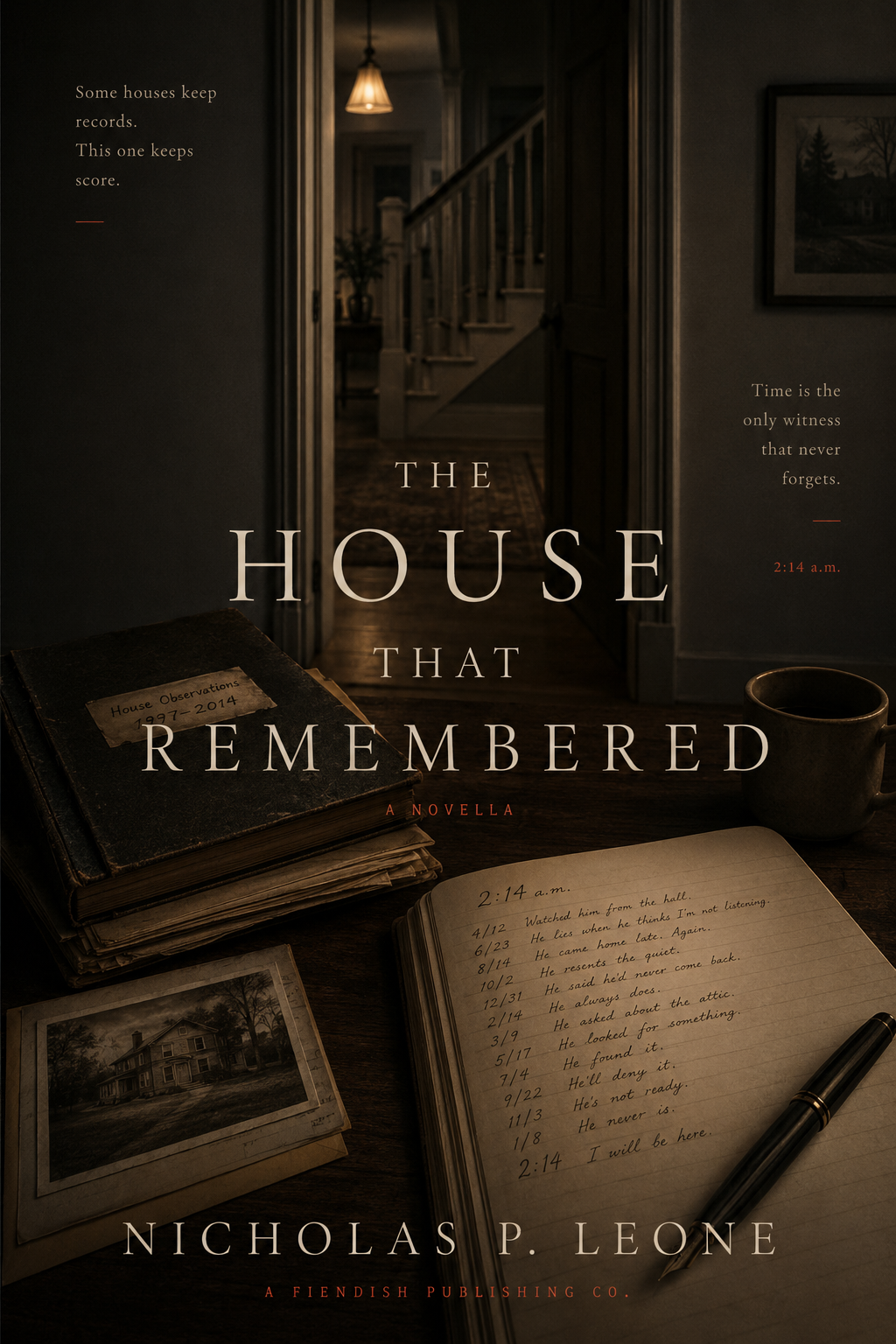
In Development The House That Remembered book cover

No. 004 · In Development

The House That Remembered Nicholas P. Leone

Novella · Literary mystery

Paper only. No cameras, no sensors, no cloud, nothing that could be accused of remembering.

Is the house haunted, or did a father simply know his son well enough to write the boy’s future before he lived it?

Open the notebooks Slated 2027 · not yet released

The Book

At 2:14 a.m., the hallway light comes on.

Daniel King doesn’t cry at his father’s funeral. He handles it — the arrangements, the estate, the keys — then stays behind to settle a house that has been labeled, dated, and written down for twenty years.

Paper only. No cameras, no sensors, no cloud, nothing that could be accused of remembering. Just notebooks in a careful hand.

March 17 — hallway light came on. 2:14 a.m.

An old house, a bad switch. Then more entries like it — garage doors, chirping detectors, a furnace that starts on its own. Every one has a boring explanation. Then Daniel lines the dates up. They are not random. They cluster on the days that mattered. 2:14 a.m. is when his mother died. And one year, in two decades of perfect records, is almost blank.

An elderly neighbor does not find it funny: “He thought the house was telling him things.”

In the attic the notebooks stop being about the house and start being about him — things his father noticed, things Daniel forgot, things Daniel remembers differently. Predictions precise enough to feel like surveillance. Then an entry dated three days after his father died, describing something only Daniel could do. Something that has not happened yet.

Is the house haunted, or did a father simply know his son well enough to write the boy’s future before he lived it?

The last notebook is blank except for one line: He will eventually understand that I wasn’t recording what happened.

He has to do one thing his father did not already write down. At 2:14 a.m., the hallway light comes on.

The People

Who lived in the house

Daniel

The son · executor

Early fifties, highly competent, emotionally guarded. Handles the funeral, the estate, and the keys without shedding a tear. Dismisses the first strange entry as a bad switch, and then cannot stop reading.

His Father

The man who wrote it all down

Meticulous to the point of eccentric. Labeled, dated, and maintained everything in the house for twenty years, by hand. Paid closer attention to his son than either of them ever said out loud.

His Mother

Remembered at 2:14 a.m.

Present only in memory, in her illness, and in the minute she died. The hour the hallway light keeps choosing.

The Neighbor

The one who isn’t laughing

Elderly, serious, direct. Watched the father’s final years from next door, and is untroubled by any of it, which is somehow worse.

Spoiler-safe · nothing here goes past what the catalog already says

From the Notebooks

Twenty years, one careful hand

March 17 — hallway light came on. 2:14 a.m.

Garage door — opened on its own. Closed it.

Smoke detector, upstairs hall — chirped.

Furnace — started without a call for heat.


Every one of these has a boring explanation.

Opening chapter coming when the manuscript locks

Particulars

Book details & formats

Details

Author
Nicholas P. Leone
Imprint
A Fiendish Publishing Co.
Catalog
No. 004
Form
Novella, about 30,000–40,000 words
Genre
Literary mystery · psychological fiction
Structure
Four acts: The House, The Pattern, What His Father Knew, The Last Entry
Status
In development · slated 2027
ISBN
Announced at release
Content notice

Grief, a parent’s death, and restrained uncanny elements. A full content notice will be posted with the finished manuscript.

Formats

PaperbackAt release
EbookAt release
AudiobookPlanned

Slated 2027 · not yet released

Behind the Book

The house rules

paper only (n.)

No smart devices, no sensors, no digital record of any kind. Dates, times, and small observations, written by hand and kept in order. Everything in the house labeled, documented, and maintained.

The book never tells you which way to read it. Every strange entry gets a plain explanation sitting right beside it, and the reader has to decide, as Daniel does, whether the house was haunted or a father simply knew his son that well. The family was never cruel. It was just unfinished.

The Catalog

Also queued to escape